Tools have beautiful silhouettes, and shrinking them into crochet miniatures makes that beauty obvious. This set of five concepts renders a toolbox, scissors, a garden spade, a hammer and a paint roller as palm-sized soft sculptures for makers' shelves. All images are AI-generated concept illustrations for inspiration, not photos of finished handmade pieces.
The five miniatures share a workshop-bright palette — tool blue, brass gold, garden green, leather tan, painter yellow — and one scale, so they display as a set. Each keeps the real tool's essential gesture: the box opens, the scissors cross, the spade digs, the hammer strikes, the roller rolls. When comparing them, notice how much of each tool is handle.
Miniature blue toolbox
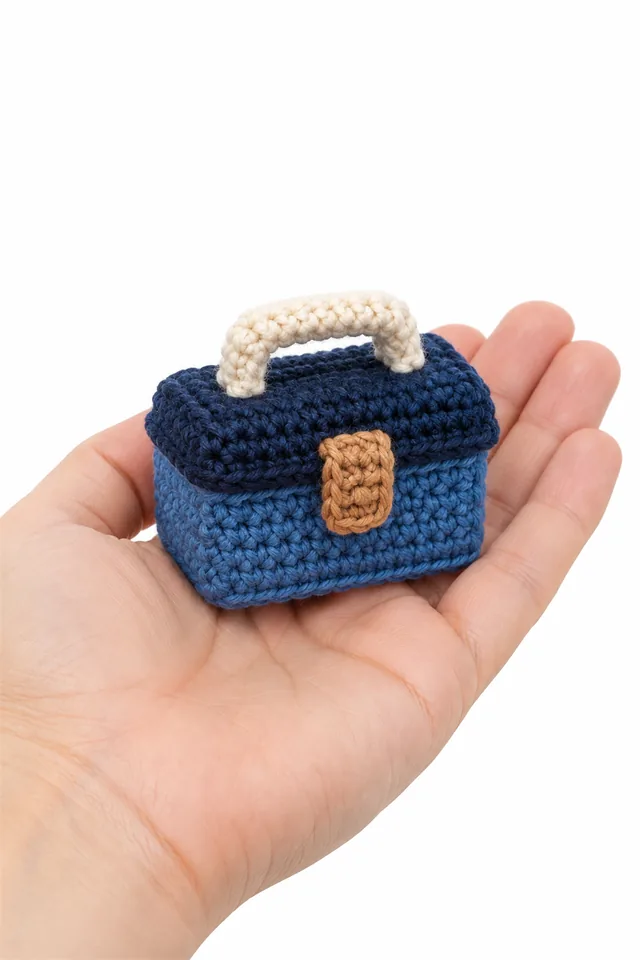
The miniature blue toolbox is the anchor of the set. Its classic cantilever shape is worked in workshop blue, with a cream handle arching over the top and a tiny stitched latch on the front. It looks like it should contain the other four tools — and in a display, it visually does.
The toolbox's success is proportion: the handle is tall enough to read instantly, and the lid line runs exactly where a real box opens. A slightly darker base gives the box weight, keeping the miniature from looking like a soft cube.
For a mood board, this piece argues for building sets around a container. Toolbox, basket, crate or bucket — one vessel gives the other miniatures a home and turns five objects into a scene. The container is the stage.
Compared with the hammer, the toolbox is potential energy where the hammer is action: one holds tools, one is one. As with every image here, treat this as an AI-generated concept for inspiration, not as a pattern.
Miniature gold scissors
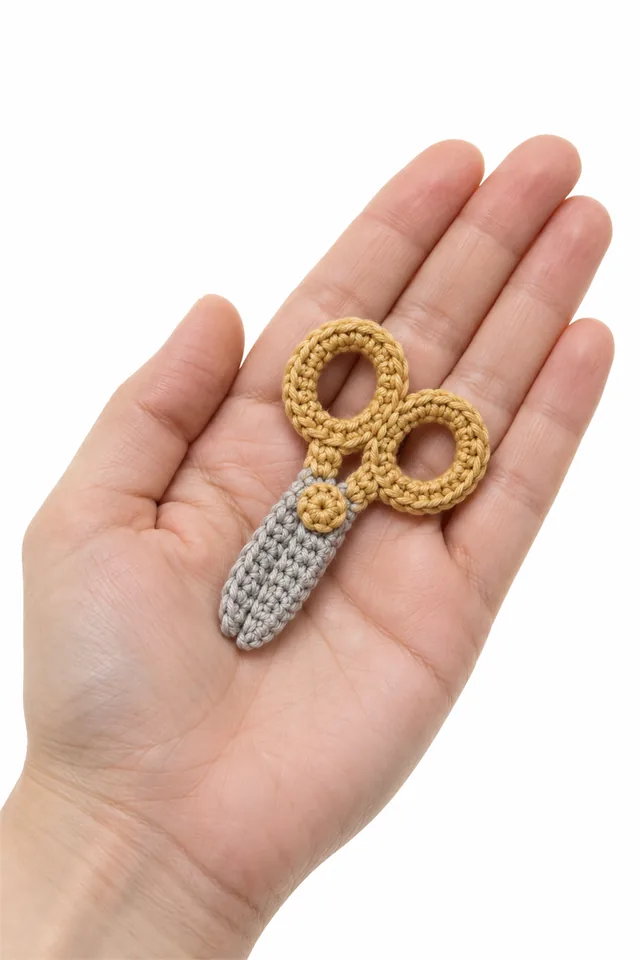
The miniature gold scissors are the most elegant tool in the set. Two blades cross in a gentle X, worked in warm brass gold, ending in round finger loops. The silhouette is unmistakable even at palm size — proof that scissors are one of the best-designed objects ever made.
Rendering scissors in gold rather than steel gray warms the whole set and nods to the brass stork scissors every crafter covets. The slight openness of the blades — not quite closed — gives the miniature a sense of readiness, as if it just snipped something.
For a mood board, these scissors show crossed-line design. Objects with an X in their anatomy — scissors, skis, oars — photograph dynamically because the eye loves intersections. Pose the cross slightly open for maximum liveliness.
Set beside the paint roller, the scissors are precision where the roller is coverage — the two poles of making. The image stays an AI concept, inspiration only, with no construction claims.
Miniature green garden spade
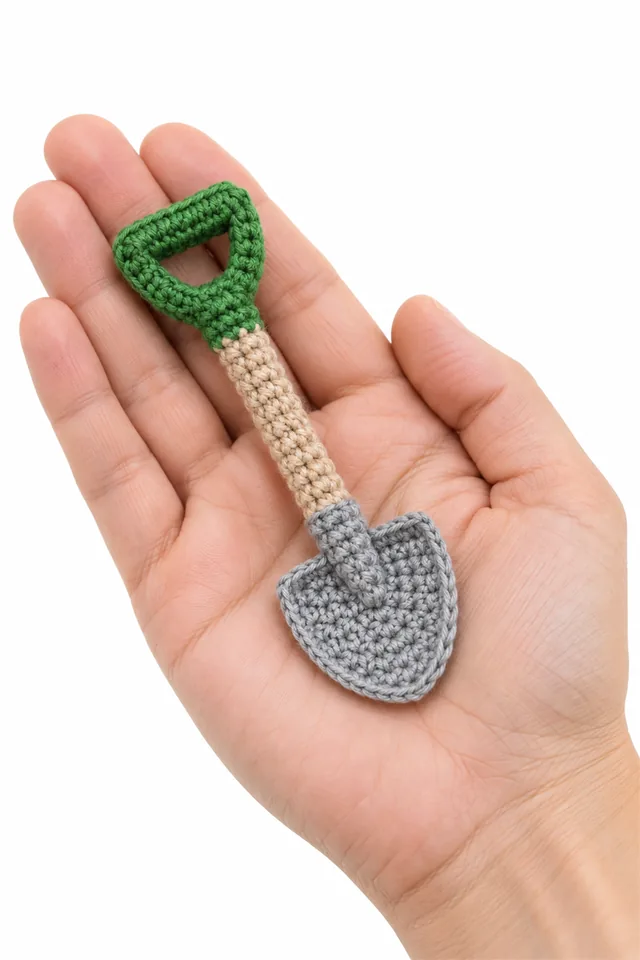
The miniature garden spade brings the set outdoors. Its green blade curves gently as if mid-scoop, and a tan T-handle tops the shaft. The color split — green below, wood tone above — mirrors exactly how real garden tools mix metal and timber.
The blade's slight tilt is the miniature's personality: a perfectly vertical spade looks catalogued, while a tilted one looks used. Small asymmetries make soft sculptures feel like portraits rather than product shots.
For a mood board, this spade demonstrates material-by-color. You can suggest wood, metal and rubber with nothing but hue changes, as long as you place each color where the real material would live. Study the real tool's color map before choosing yarns.
Next to the hammer, the spade digs where the hammer strikes — both are single-purpose gestures, which is why both miniaturize so well. As always, this is an AI-generated concept image: take the pose idea, not the making details.
Miniature tan hammer
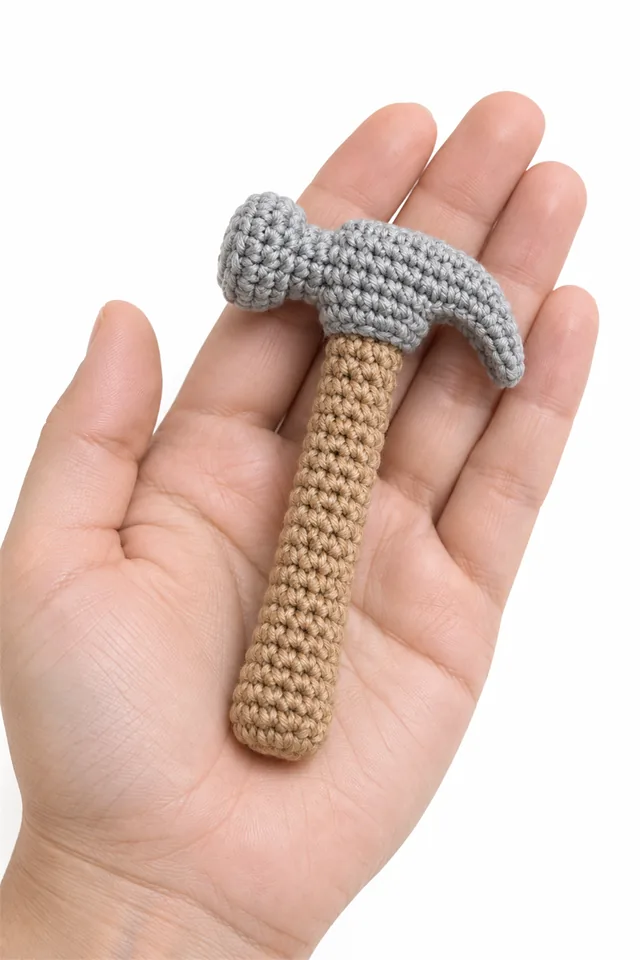
The miniature tan hammer has the strongest gesture in the set: head raised, handle angled, forever about to strike. The tan shaft contrasts with a darker head whose claw is suggested in a few curved stitches. It is the toolbox's most loyal resident.
The hammer works because its anatomy is pure contrast: light handle, dark head. That two-block structure is instantly readable at any size, which is the definition of a good miniature subject. The angled pose adds the energy the simple shape needs.
For a mood board, this hammer teaches pose-as-design. Static tools — hammers, saws, brushes — gain life from a working angle. Decide what the tool is doing, then freeze it mid-action. Inanimate objects can still have verbs.
Compared with the scissors, the hammer is blunt force where the scissors are precision — yet both are really about hands. Both are AI-generated concepts for inspiration, with no claim about real construction.
Miniature yellow paint roller
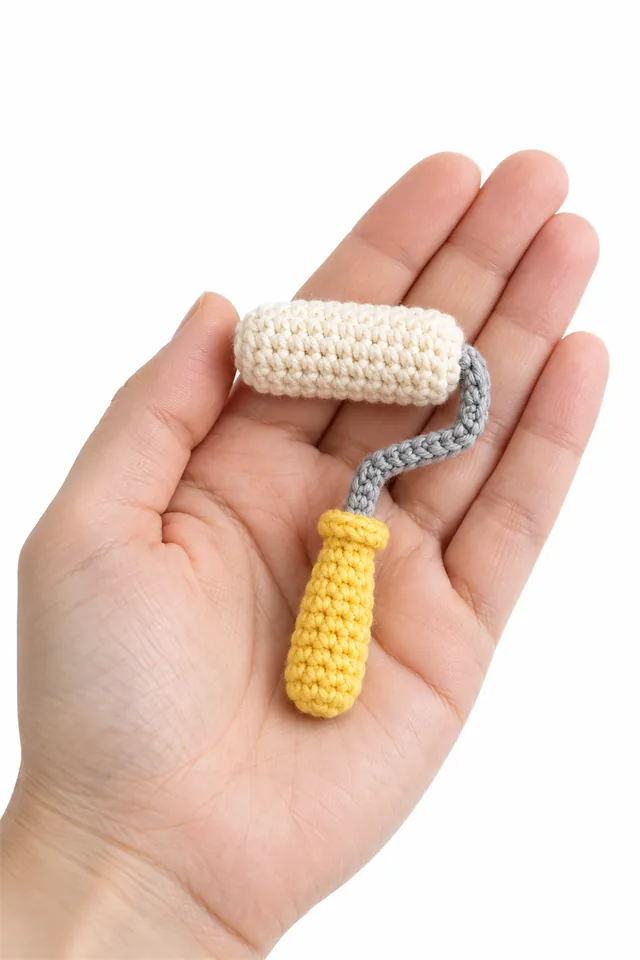
The miniature yellow paint roller is the most contemporary tool of the five. Its cream sleeve is textured to suggest a nap loaded with paint, and the yellow frame and handle bend in the roller's signature zigzag. A faint color band on the sleeve hints at a wall half-painted.
The roller is a modern shape — L-bend wire, cylinder sleeve — and including it keeps the set from feeling like a museum of old tools. The yellow frame against the cream sleeve is a fresh, optimistic pairing, the color of renovation and new rooms.
For a mood board, this roller shows the value of one contemporary piece in a classic set. Mixed eras make collections feel curated rather than themed. If your miniatures all come from one century, add one that does not.
Set against the spade, the roller covers surfaces where the spade moves soil — both transform environments, one indoors, one out. All five images are AI-generated concepts for inspiration only, not patterns or product photos.
A workshop in miniature
The five miniatures share one idea: tools are portraits of the hands that use them. Box, scissors, spade, hammer and roller each reduce a whole craft to one soft object, and together they form a pocket-sized workshop.
When planning a tool miniature, study the real object's color map and its working pose. Get the handle right, give the tool a verb, and the likeness takes care of itself.
All five images are AI-generated concept illustrations. They offer ideas for subjects, poses and palettes, but they are not photographs of finished crocheted pieces and include no patterns or instructions. Use them as a springboard for your own miniature mood board.
Read how we present crochet inspiration or send a suggestion or correction.