Art deco was made for yarn: bold geometry, sunbursts, chevrons and stepped arches all translate beautifully into crochet fabric. This set of five blouse concepts dresses the decade's glamour in modern, wearable silhouettes. All images are AI-generated concept illustrations for inspiration, not photos of finished handmade pieces.
The five pieces share the deco palette — black and gold, copper and navy, emerald, ivory with sapphire, deep wine — but each borrows a different motif from the era: fans, rays, arches, chevrons and frames. When comparing them, notice where the geometry sits: yoke, body or edge. Placement is what turns a pattern into a garment.
Black and gold fan-yoke top
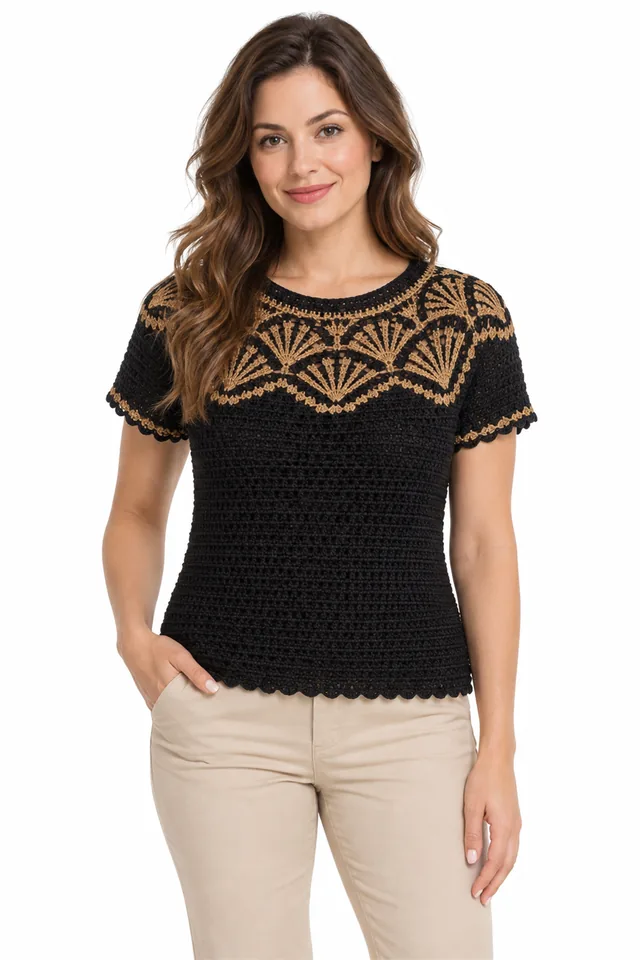
The black and gold fan-yoke top is pure Gatsby. Across the yoke, golden fans open in a row like a theater footlight, their rays spreading over a deep black body. The contrast is the whole story: midnight below, gilded geometry above.
Concentrating the motif at the yoke is smart garment design. The face gets all the decoration, the body stays simple and slimming, and the piece pairs with plain trousers without competing. Gold on black also photographs with a glow that few color pairs can match.
For a mood board, this top shows the yoke as a stage. Any strong motif — fan, sunburst, skyline — earns more attention at the neckline than scattered over the whole garment. Decorate where the eye naturally lands first, and let the rest of the fabric play support.
Compared with the wine geometric-frame top, the fan-yoke is frontal and festive where the frame top is architectural and restrained. One performs, the other composes. As with every image here, treat this as an AI-generated concept for motif placement, not as a pattern.
Copper and navy ray blouse
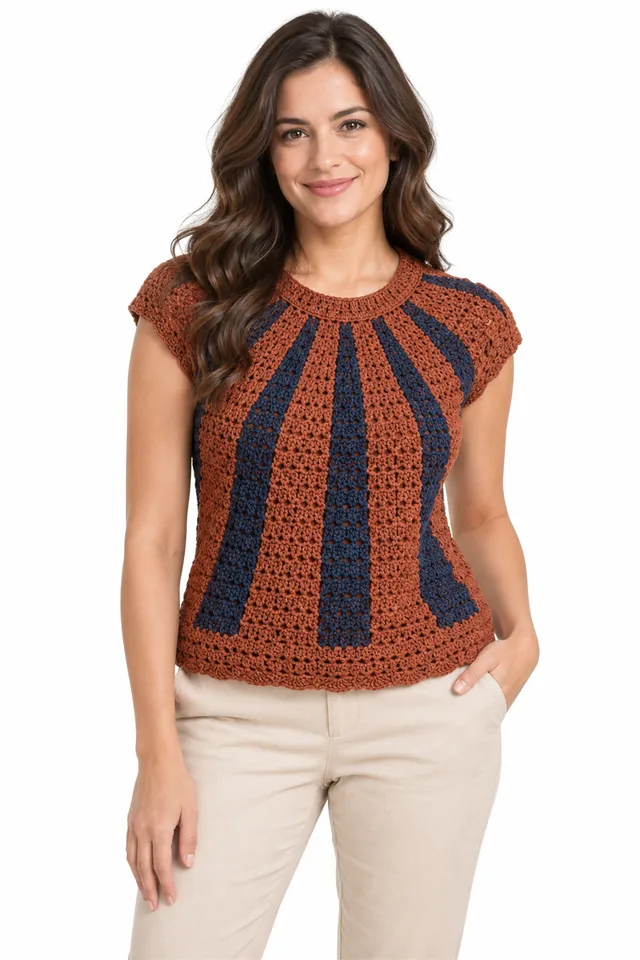
The copper and navy ray blouse radiates quietly. From a point at the chest, copper rays fan downward and outward over a navy ground, like a sunrise caught mid-spread. The metallic warmth of copper keeps the dark base from ever feeling somber.
Ray motifs have a built-in direction, and this blouse uses that well: the rays point toward the hem, visually lengthening the torso. Navy is doing quiet work too — softer than black, it flatters the copper and suits daylight wear in a way pure evening black would not.
For a mood board, this blouse demonstrates directional motifs. A pattern that points somewhere — up, down, out — changes the perceived proportions of the wearer. Decide what you want to elongate before you choose where the rays begin.
Set beside the emerald stepped-arch tunic, the ray blouse is all movement while the tunic is all structure. Deco contained both energies, and so should a collection. The image stays an AI concept, inspiration only, with no construction claims.
Emerald stepped-arch tunic
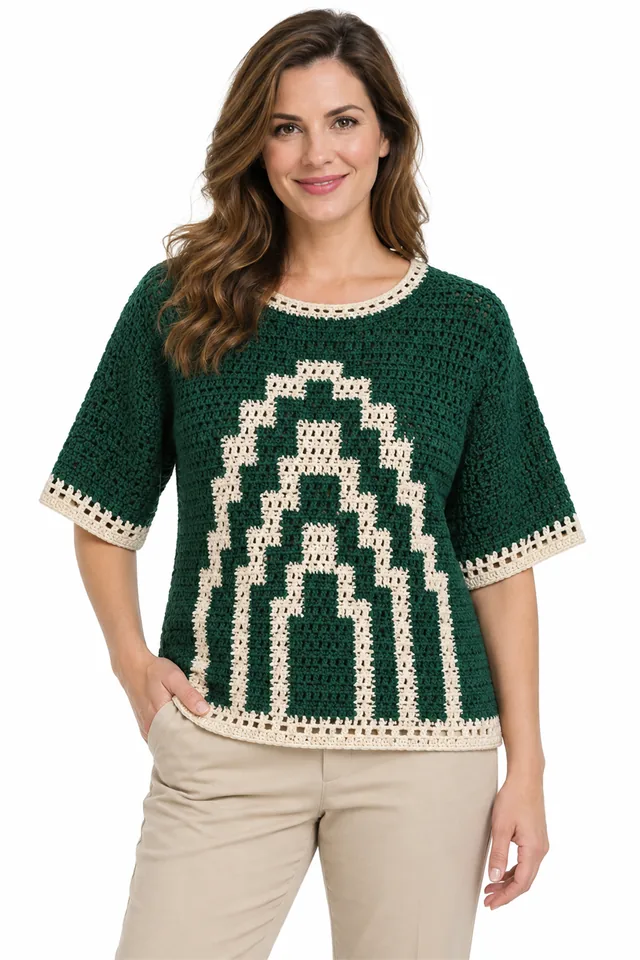
The emerald stepped-arch tunic borrows its silhouette from a skyline. Rows of stepped arches, like miniature Chrysler Building crowns, climb the body in tonal bands of emerald and jade. The longer tunic length gives the motif room to repeat, and repetition is where deco shines.
Tonal layering is the design's quiet engine: three close greens create depth without a single contrasting color. The stepped arches supply vertical rhythm, and the tunic's clean hem and cuffs frame the pattern like architectural trim.
For a mood board, this tunic argues for monochrome confidence. Pick one rich color, split it into three depths, and let a strong geometric repeat carry the piece. It is a formula that reads expensive in photographs and forgiving in wear.
Next to the chevron cardigan, the tunic is serene where the cardigan is energetic — arches rise calmly, chevrons zig. Together they show two deco moods. As always, this is an AI-generated concept image: take the motif idea, not the making details.
Ivory and sapphire chevron cardigan
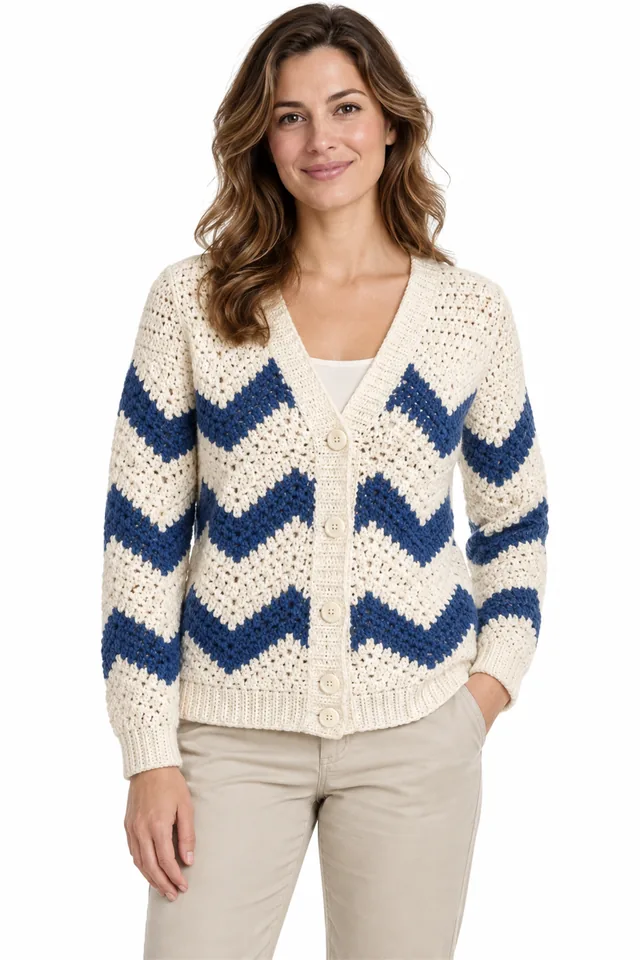
The ivory and sapphire chevron cardigan is the brightest piece of the five. Crisp ivory sets the stage while sapphire chevrons zigzag across the body in confident bands. The V of the chevrons echoes the V of the cardigan's opening, a small harmony that makes the design feel inevitable.
Chevrons are deco's friendliest motif: energetic but legible, bold but easy to place. On a cardigan they do double duty, drawing the eye along the button line and giving the open front a finished, intentional look. Ivory keeps the whole thing light enough for spring.
For a mood board, this cardigan shows motif-echo. When a garment has a strong built-in line — an opening, a seam, a collar — choose a pattern that rhymes with it. Chevrons with a V-neck, ribs with a straight placket, fans with a round collar.
Compared with the fan-yoke top, the cardigan spreads its pattern everywhere while the top concentrates it at the neckline. Allover versus accent is the fundamental placement choice. Both are AI-generated concepts for inspiration, with no claim about real construction.
Wine geometric-frame top
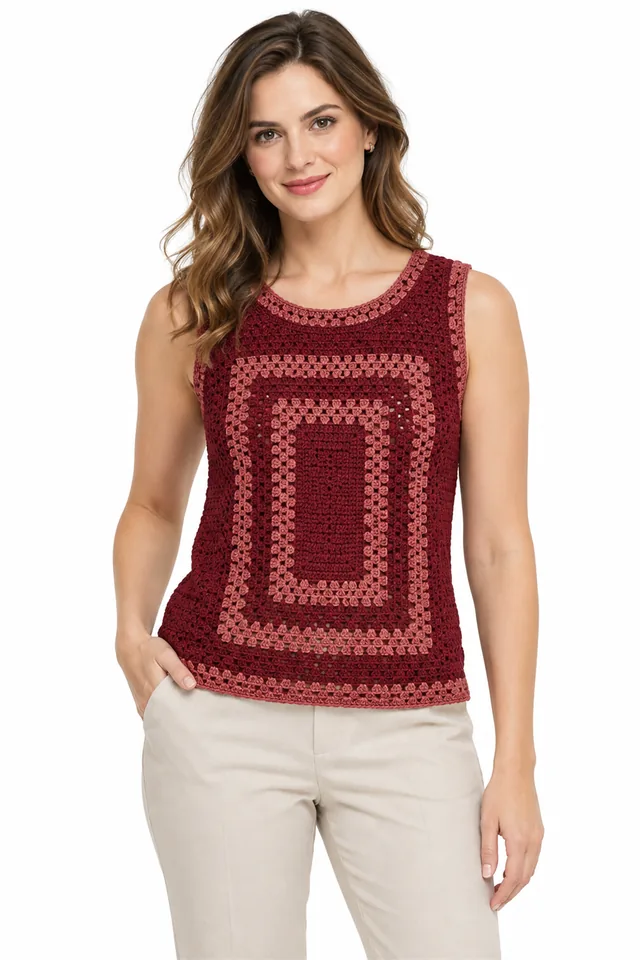
The wine geometric-frame top is the most tailored of the set. Deep wine fabric is bordered by geometric frame lines — stepped rectangles tracing the neckline and hem like the gilt borders of a deco poster. The ornament is all outline, and the restraint is the luxury.
Frame borders work on garments for the same reason they work on posters: they declare the edges. A bordered hem ends the top with a period instead of a fade, and a traced neckline needs no jewelry. Wine red, deep and warm, makes the geometry feel like velvet architecture.
For a mood board, this top teaches the power of outlining. If allover pattern feels like too much, outline the garment's own architecture — hem, cuff, collar — and stop there. The garment becomes its own frame, and the wearer supplies the picture.
Set against the ray blouse, the frame top is stillness against movement, border against burst. Deco posters used both on the same page; a wardrobe can too. All five images are AI-generated concepts for inspiration only, not patterns or product photos.
Deco geometry, modern wardrobe
The five blouses prove that art deco is really a placement language: fans at the yoke, rays along the body, arches in repeat, chevrons echoing an opening, frames tracing the edges. Choose the motif's address first and the era's glamour follows by itself.
When planning a deco-inspired garment, limit yourself to one motif and two colors per piece. The style's confidence comes from discipline — the posters of the era never cluttered, and neither should the fabric.
All five images are AI-generated concept illustrations. They offer ideas for motifs, placement and palette, but they are not photographs of finished crocheted pieces and include no patterns or instructions. Use them as a springboard for your own deco mood board.
Read how we present crochet inspiration or send a suggestion or correction.