Blankets are big enough to hold a whole landscape, and this set of five crochet throw concepts finds its landscapes in alpine lichens. Double borders, stepped panels, diamond patches, oval insets and vertical ribbons each translate a lichen's growth pattern into blanket geometry. All images are AI-generated concept illustrations for inspiration, not photos of finished handmade pieces.
The five throws share the lichen palette — coral, pale cup green, golden crust, sage and stone gray — but each organizes that palette differently. Some radiate, some stripe, some frame. When comparing them, watch where the eye is pulled: center, edge or rhythm. That choice is the real design decision in any blanket.
Coral lichen double-border throw
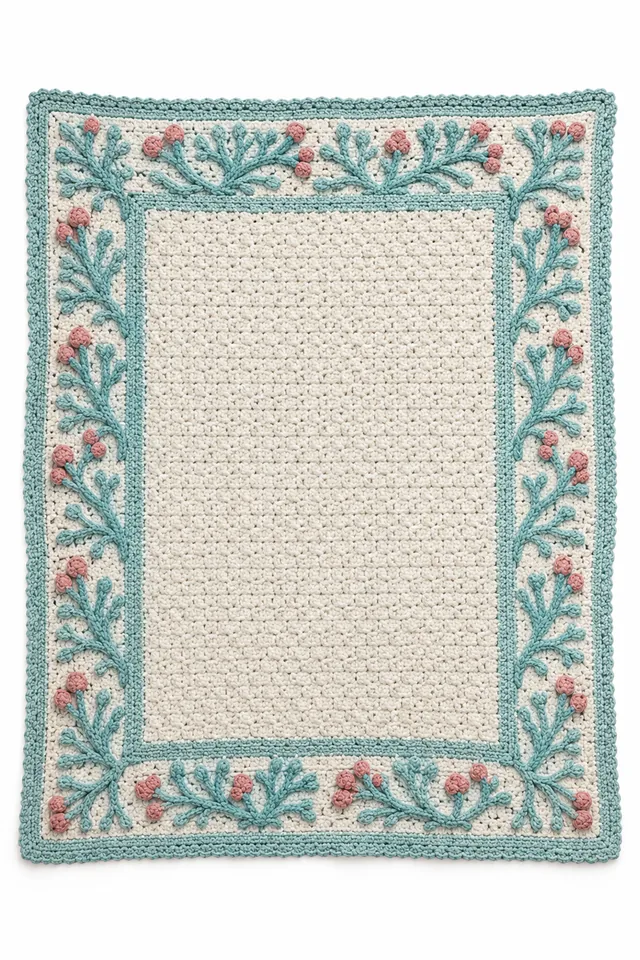
The coral double-border throw leads with warmth. A soft coral field, gently nubby like its lichen namesake, is wrapped by two concentric borders — a narrow inner line and a wide outer band in deeper tones. The effect is a blanket that frames itself, like a picture that comes with its own mat.
Doubling the border is a small decision with a big payoff: it gives the edge weight, so the throw drapes with presence instead of flopping. The inner stripe acts as a shadow line, separating field from frame and making the coral center feel intentional rather than plain.
For a mood board, this throw teaches border hierarchy. When a blanket feels unfinished, the answer is often not more pattern in the middle but more structure at the edge. Try pairing a quiet field with two or even three border rounds in stepped shades of one color.
Compared with the vertical-ribbon throw, the double-border design reads classic and centered, while the ribbons read modern and directional. Both live happily in the same palette family. As with every image here, treat this as an AI-generated concept for layout inspiration, not as a pattern.
Cup lichen stepped-panel throw
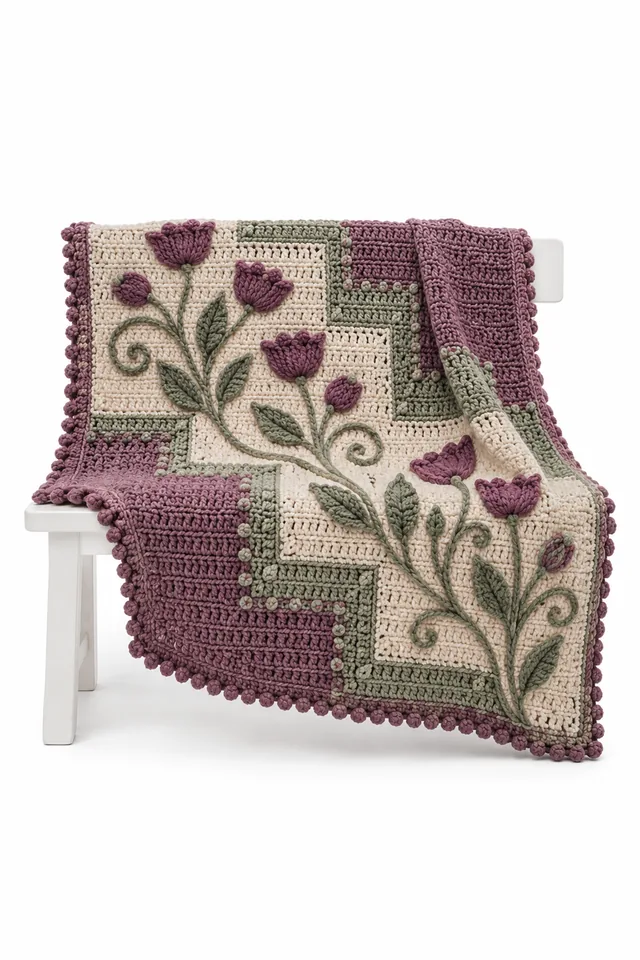
The cup lichen stepped-panel throw builds its design like a staircase. Pale green panels step up and across the surface in offset tiers, echoing the way cup lichens stack their tiny goblets along a branch. The rhythm is architectural but the color keeps it soft.
Stepping panels instead of striping them creates movement without any color change: the eye climbs the steps naturally. Subtle shade shifts between tiers — sage into celadon into cream — reinforce the climb and keep the single-family palette from ever feeling flat.
For a mood board, this concept shows the strength of modular thinking. A blanket of repeated stepped units is easier to plan than an all-over scene, and the modules photograph beautifully folded over a chair arm. Structure first, decoration second.
Set beside the diamond-patch throw, the stepped panels feel calm and sequential where the diamonds feel sparkling and scattered. One is a staircase, the other a constellation — two valid ways to fill a rectangle. The image stays an AI concept, inspiration only.
Golden crust lichen diamond-patch throw
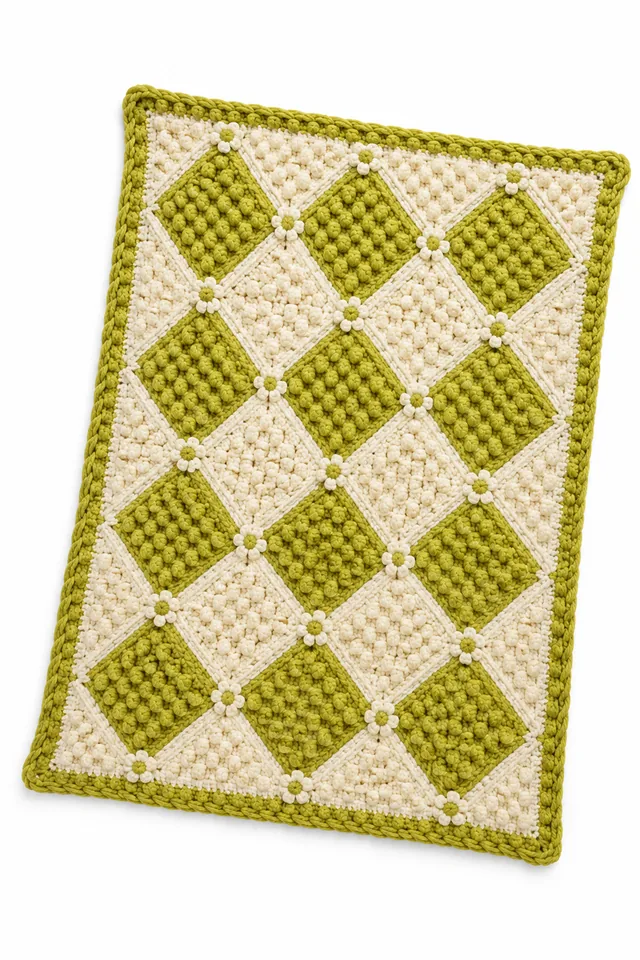
The golden diamond-patch throw is the jewel of the set. Mustard-gold diamonds, textured like crust lichen spreading in rosettes, are scattered across a quieter ground in an even grid. Each diamond reads as a little sun, and together they turn the blanket into a field of warm spots.
Placing motifs on points — diamonds rather than squares — instantly adds energy, because diagonal lines feel active where right angles feel settled. The generous spacing between patches matters just as much as the patches themselves: breathing room is what makes each diamond glow.
For a mood board, this throw demonstrates motif spacing. Crowded motifs make a blanket busy; widely spaced motifs make it elegant. If a design feels loud, try doubling the ground between motifs before changing anything else. Restraint is a feature, not a compromise.
Next to the stepped-panel throw, the diamonds are playful punctuation against the other's calm paragraphs. Together they show two temperatures of the same gold. As always, this is an AI-generated concept image: take the layout idea, not the construction details.
Reindeer lichen oval-inset throw
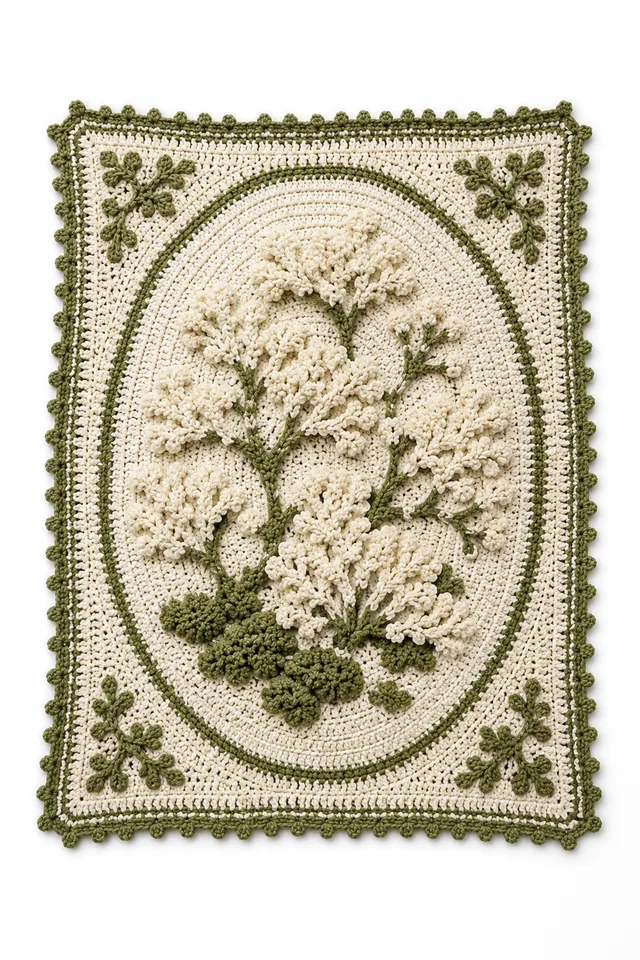
The reindeer lichen oval-inset throw is the romantic of the collection. A sage field surrounds a large central oval, worked in paler branching texture like reindeer lichen itself. The oval sits like a medallion, turning the whole blanket into a frame for one soft centerpiece.
An oval inset breaks the tyranny of the rectangle without any difficult shaping at the edges: the blanket stays a simple oblong, while the interior shape supplies the surprise. A thin outline around the oval sharpens the effect, the way a mat sharpens a picture.
For a mood board, this concept argues for a single focal point. Many blankets scatter attention everywhere; this one concentrates it. A centered medallion suits beds and folded-over-sofa styling, because the focal shape stays visible even when the edges disappear.
Compared with the coral double-border throw, the oval inset puts its ornament in the middle instead of at the rim — frame versus centerpiece. Both are framing strategies, just pointing in opposite directions. Both are AI-generated concepts for inspiration, with no claim about real construction.
Rock shield lichen vertical-ribbon throw
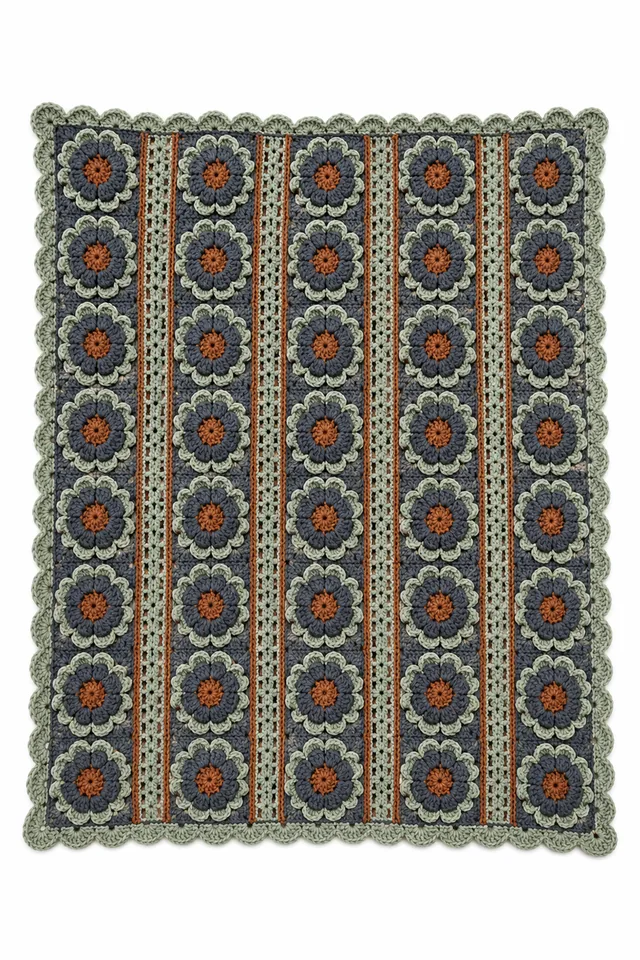
The rock shield vertical-ribbon throw is the most graphic of the five. Vertical ribbons of stone gray and charcoal run the length of the blanket, separated by slim light lines, like lichen shields lined up along a rock face. The result is calm, tailored and unmistakably modern.
Vertical ribbons lengthen a throw visually, which flatters both the piece and the furniture under it. Alternating ribbon widths — wide, narrow, wide — adds rhythm without adding colors. The light separating lines are the unsung heroes: they keep the dark bands distinct and crisp.
For a mood board, this throw shows how direction changes mood. The same stripes run horizontally would feel nautical and casual; run vertically they feel architectural. Before choosing colors for a striped blanket, choose the direction — it decides more than the palette does.
Set against the diamond-patch throw, the ribbons are all discipline where the diamonds are all play. A blanket collection needs both a comedian and a poet. All five images are AI-generated concepts for inspiration only, not patterns or product photos.
Five ways to fill a rectangle
The five throws answer the same question — how do you organize a big rectangle? — with five different logics: frame it, step it, dot it, center it or stripe it. The shared lichen palette proves that color unity and structural variety can coexist in one collection.
When planning a blanket, decide first where the eye should land: edge, center or everywhere at once. That single choice narrows every later decision, from border depth to motif spacing, more than any color card will.
All five images are AI-generated concept illustrations. They offer ideas for layout, palette and texture, but they are not photographs of finished crocheted pieces and include no patterns or instructions. Use them as a springboard for your own blanket mood board.
Read how we present crochet inspiration or send a suggestion or correction.